

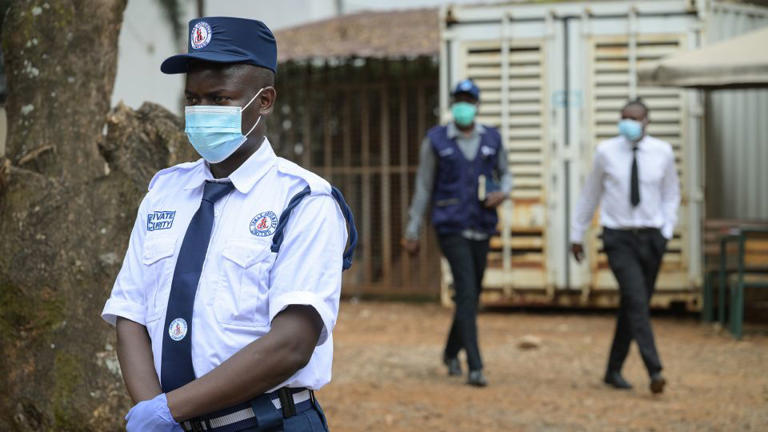
Kenya is on high alert after confirming an imported case of Ebola, raising fresh concerns about the risk of the deadly virus spreading across international borders.
The patient, who had traveled from the Democratic Republic of Congo through Uganda before arriving in Nairobi, reportedly passed airport health screenings without being identified as a suspected Ebola case. He later tested positive for the Bundibugyo strain of the virus and died several days afterward.
The case has exposed the challenges facing health authorities as they attempt to control an outbreak in the Democratic Republic of Congo, where thousands of cases and deaths have been reported. Health officials are now working to trace potential contacts, strengthen surveillance, and prevent further transmission.
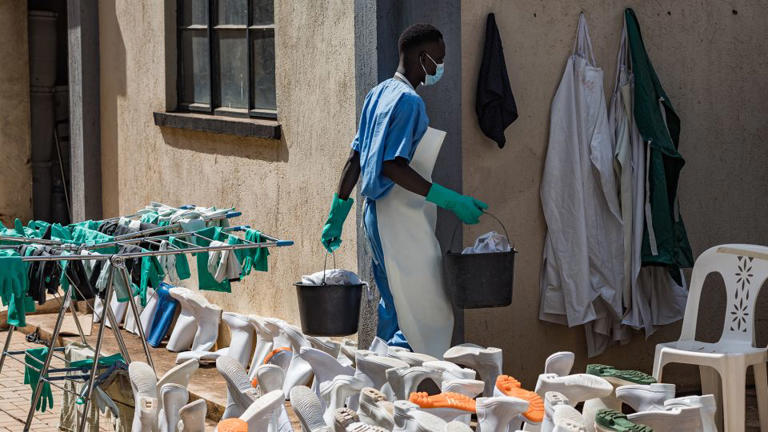
Kenya’s efforts to prepare for Ebola are facing a serious test after the country confirmed its first imported case of Bundibugyo virus disease during the current outbreak.
According to Kenya’s Ministry of Health, the patient was a man who had spent approximately seven years living in the Democratic Republic of Congo. After becoming ill, he traveled across several borders before reaching Kenya’s capital, Nairobi.
Authorities said the man traveled by road from eastern Congo through Uganda before boarding a flight to Nairobi. He arrived on October 3 with symptoms that included fever, chills, severe fatigue, muscle pain, and bleeding beneath the skin.
He was taken to Nairobi Hospital, where medical personnel isolated him and conducted diagnostic tests. The results confirmed infection with the Bundibugyo strain of Ebola. The patient died days later, on Monday, according to the account provided in the report.
Kenyan health authorities are now working to identify people who may have come into contact with him and assess the risk of further infections.
The case highlights how quickly an outbreak in one country can become a regional public health concern.
The Democratic Republic of Congo is at the center of a major Ebola outbreak, with the World Health Organization reporting thousands of confirmed cases and deaths across several provinces.
The WHO has warned that the risk to neighboring countries sharing land borders with Congo remains high because transmission is continuing in affected areas.
Kenya is not the only country to have faced cases linked to the wider outbreak. Uganda previously reported imported infections before declaring itself Ebola-free in July, while France also reported a travel-related case, according to the article.
Kenya has now joined the countries affected by the spread of the Bundibugyo virus beyond Congo.
Oyewale Tomori, a former World Health Organization regional virologist for Africa, warned that the Kenyan case demonstrates the difficulty of containing an outbreak when people continue to travel between countries.
He emphasized that porous borders and frequent cross-border movement can allow infections to spread before authorities detect them.
One of the central questions is how the patient traveled through the region without being identified as a suspected Ebola case.
According to information attributed to the Kenyan and Ugandan health authorities, the man traveled from eastern Congo to Kampala before flying to Nairobi.
Uganda’s health ministry said he spent less than 24 hours in the country and had a normal temperature during screening before departing from Entebbe International Airport.
Kenya’s Ministry of Health also said he underwent routine public health screening at Jomo Kenyatta International Airport. The information provided indicates that he was not flagged as a suspected Ebola patient at that time.
Authorities have not established publicly, in the information cited, what screening took place at the land border between Congo and Uganda.
The World Health Organization has also indicated that the exact point at which the patient developed Ebola symptoms during his journey remains unclear. His prolonged illness has raised questions about whether his initial symptoms were caused by another condition before he later contracted the virus.
The case demonstrates a major weakness in relying on temperature checks alone: an infected traveler may not have a fever at the precise moment of screening.
Health specialists say the challenge extends beyond airports and official border crossings.
People regularly move between eastern Congo and neighboring countries for employment, trade, healthcare, and family reasons. Some use informal routes that are difficult for authorities to monitor.
The International Organization for Migration has warned that these movements make it impossible for airport and border screening to identify every potentially infected traveler.
Christian Happi, a professor of molecular biology and genomics at Redeemer’s University in Nigeria, argues that temperature screening has limitations because an infected person may not be experiencing a fever when passing through a checkpoint.
Happi has proposed requiring travelers departing from affected areas to present negative Ebola tests before boarding flights. However, this is his recommendation, not the current general requirement under World Health Organization guidance.
The WHO’s guidance emphasizes screening for possible exposure and symptoms at relevant departure points, while preventing suspected, probable, and confirmed cases, as well as certain exposed contacts, from traveling internationally except for medical evacuation.
The agency has also advised against broad travel and trade restrictions targeting affected countries.
Following confirmation of the imported case, Kenyan health officials intensified surveillance and screening at Nairobi’s Jomo Kenyatta International Airport.
Authorities are also attempting to identify people who may have been exposed to the patient and ensure that anyone at risk is appropriately assessed.
There has been at least one additional development offering some reassurance. According to Kenyan authorities cited in a Reuters report, preliminary tests on a separate 20-year-old patient who had traveled from Congo through Uganda returned negative for Ebola on Thursday.
That result does not eliminate the possibility of further cases, but it underscores the importance of rapid testing and timely investigation whenever a suspected infection is identified.
Health specialists say contact tracing, laboratory capacity, information sharing, and community surveillance are essential parts of the response.
Experts are also pointing to Nigeria’s response during the 2014 West African Ebola epidemic as an example of how an imported infection can be contained.
At that time, an Ebola case arrived in Lagos, one of Africa’s largest and most densely populated cities. The outbreak resulted in 20 cases and eight deaths before transmission was stopped.
According to researchers, rapid detection, contact tracing, and coordination among health authorities played an important role in containing the spread.
Christian Happi says the central lesson is that countries cannot rely entirely on preventing every infected traveler from crossing a border. Instead, they must be capable of identifying imported cases quickly and preventing them from infecting others.
The response also faces medical challenges. According to the source article, there is no licensed vaccine or approved specific treatment for the Bundibugyo strain, although potential vaccines and treatments are being investigated.
This makes early diagnosis, supportive medical care, isolation when appropriate, and the rapid identification of contacts especially important.
Health authorities must also communicate clearly with the public, encourage people with possible symptoms or exposure to seek medical attention, and counter misinformation that could undermine the response.
Kenya’s imported Ebola case serves as a warning that even extensive preparation and airport screening cannot guarantee that every infection will be detected before it crosses a border.
As the outbreak continues in the Democratic Republic of Congo, neighboring countries face the challenge of strengthening cooperation while maintaining essential travel and trade.
For health experts, the priority is clear: detect infections quickly, trace contacts efficiently, share information across borders, and act before imported cases lead to further transmission.
The coming days will be critical as Kenyan authorities work to determine whether the infection has spread to anyone else.
Reporting by Ehud Jones For SNEWS TV.