
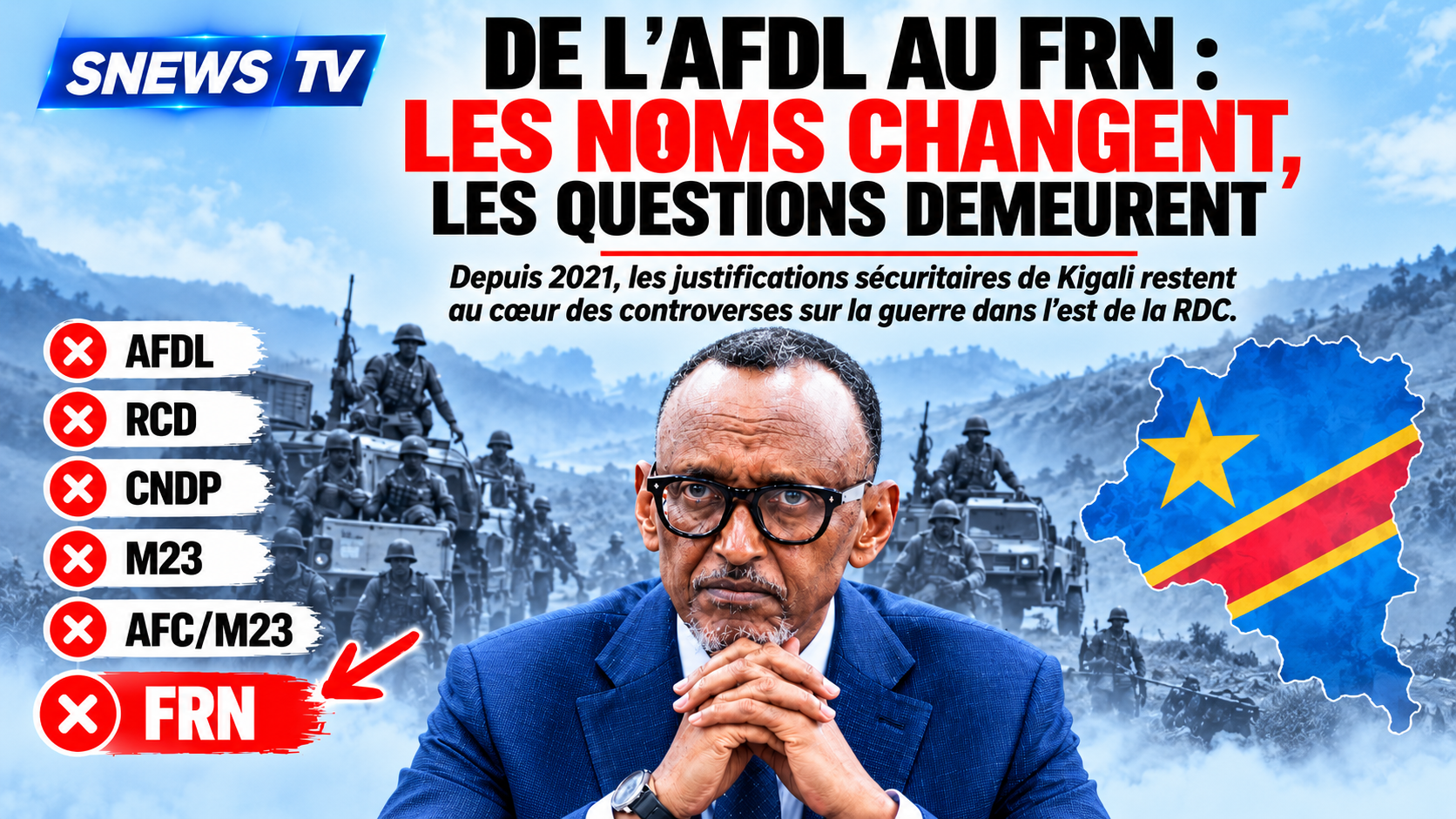
Since fighting involving the M23 rebel movement resumed in 2021, Rwandan President Paul Kagame has repeatedly cited security concerns to explain his country’s position in the conflict in the eastern Democratic Republic of Congo.
Kigali points to the threat posed by the Democratic Forces for the Liberation of Rwanda, known as the FDLR, the protection of Congolese Tutsis and the Banyamulenge community, as well as longstanding historical disputes. However, United Nations reports alleging Rwandan military support for the M23 have intensified international scrutiny of these arguments.
With the emergence of the National Resistance Front, known as the FRN, and its reported association with former Congolese President Joseph Kabila, the debate is taking on a new political dimension.
KIGALI’S SECURITY ARGUMENTS
Rwanda has consistently highlighted the presence of the FDLR, an armed group whose origins include individuals linked to the perpetrators of the 1994 genocide against the Tutsi in Rwanda.
Kigali also argues that the security and protection of Congolese Tutsis, including the Banyamulenge community, are important regional concerns. Historical grievances and cross-border security threats have likewise featured prominently in Rwanda’s explanation of its position.
Rwandan authorities present these issues as matters of national security. However, the Democratic Republic of Congo and several international actors have challenged Rwanda’s actions and questioned whether these concerns justify its alleged involvement in the conflict on Congolese territory.
UN REPORTS INTENSIFY INTERNATIONAL SCRUTINY
United Nations reports alleging Rwandan military support for the M23 have become central to the dispute between Kinshasa and Kigali.
The Congolese government considers the alleged support a violation of its sovereignty and a major obstacle to peace in the eastern part of the country. Rwanda, meanwhile, continues to emphasize the security threats it says originate from Congolese territory.
This leaves a fundamental question: to what extent do the security concerns raised by Kigali explain its policies, and how should those concerns be addressed without undermining the territorial integrity of the Democratic Republic of Congo?
Combating armed groups and protecting vulnerable communities are legitimate security concerns. At the same time, states remain bound by international law, including obligations relating to sovereignty and territorial integrity.
JOSEPH KABILA AND THE EMERGENCE OF THE FRN
The reported emergence of the National Resistance Front, or FRN, associated with former Congolese President Joseph Kabila, adds another political dimension to the crisis.
This development raises questions about the shifting political and military balance surrounding the conflict, as well as the influence of different actors seeking to shape the future of eastern Congo.
It also highlights the complex relationship between regional security concerns, domestic political rivalries and the interests of the parties involved.
However, claims about the FRN’s role and its relationship with other armed or political actors must be assessed against independently verified information. Political interpretations should not be confused with established facts.
THE HUMAN COST OF THE CONFLICT
Beyond political statements and diplomatic disputes, civilians in eastern Congo continue to bear the consequences of the violence.
Displacement, insecurity, disrupted economic activity and limited access to essential services remain major concerns for affected communities.
A sustainable resolution will require practical measures to reduce external support for armed groups, protect civilians, address cross-border security threats and implement diplomatic commitments that can be independently monitored.
Ultimately, the challenge is not simply to compare the arguments presented by Kigali and Kinshasa. It is to identify concrete steps capable of ending the violence while respecting Congo’s sovereignty and addressing legitimate regional security concerns.
President Paul Kagame’s security arguments remain at the centre of the controversy surrounding the conflict in eastern Congo. The threat posed by the FDLR, the protection of vulnerable communities and allegations of Rwandan support for the M23 continue to shape the debate between the two countries.
With new political developments involving the FRN and Joseph Kabila, the crisis extends beyond the battlefield to questions of political influence, regional stability and national sovereignty.
The central question remains: can the security concerns cited by Kigali contribute to a lasting peace, or will the continued confrontation deepen a crisis that has already exacted a devastating toll on Congolese civilians?
Reporting by Ehud Jones For SNEWS TV.