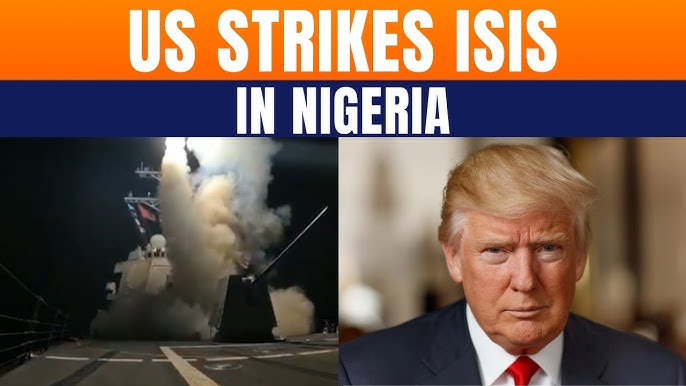
The United States has carried out airstrikes in Nigeria, targeting militants linked to the Islamic State group. The strikes follow weeks of sharp criticism from President Donald Trump, who has accused Nigeria’s government of failing to stop violent attacks—particularly against Christian communities.
President Trump announced the operation in a Christmas evening post on social media, describing the strikes as “powerful and deadly.” He said they were aimed at Islamic State–aligned militants operating in northwestern Nigeria. However, the president did not provide specific details about the targets or the damage caused.
A U.S. Defense Department official, speaking on condition of anonymity, confirmed that the strikes were carried out in coordination with the Nigerian government and were approved by authorities in Abuja. Nigeria’s Ministry of Foreign Affairs echoed that account, saying the operation involved intelligence sharing and strategic coordination consistent with international law and respect for Nigeria’s sovereignty.
SNEWS TV has not independently confirmed the extent or impact of the airstrikes.
Nigeria continues to battle multiple armed groups across the country. Among them are factions affiliated with the Islamic State, including the Islamic State West Africa Province—an offshoot of Boko Haram operating mainly in the northeast—as well as the lesser-known Lakurawa group, active in the northwest.
Security analysts suggest the Lakurawa group may have been the target of the U.S. strikes. The group has grown increasingly violent over the past year, using forested areas as hideouts and launching attacks on remote communities and security forces.
Malik Samuel, a Nigerian security researcher with Good Governance Africa, says extremist groups have been able to expand in areas where state authority is weak, particularly in parts of Sokoto and neighboring states.
President Trump said the strikes were a response to attacks by militants he claims have been “targeting and viciously killing innocent Christians.” Nigerian officials, however, stress that extremist violence has affected both Christians and Muslims, noting that terrorism in any form threatens national unity and regional stability.
Nigeria’s population of roughly 220 million people is nearly evenly split between Christians and Muslims, and the country’s insecurity is driven by a complex mix of factors. These include religious extremism, disputes between farmers and herders, ethnic and communal violence, and separatist movements.
The airstrikes come amid growing pressure from Washington. Last month, President Trump ordered the Pentagon to begin planning possible military options in Nigeria. The State Department has also announced visa restrictions for Nigerians linked to violence against Christians and recently designated Nigeria a “country of particular concern” under the International Religious Freedom Act.
Defense Secretary Pete Hegseth underscored the administration’s position in a post Thursday night, saying U.S. forces were ready to act and thanking the Nigerian government for its cooperation.
Despite the strikes, analysts note that the U.S. military footprint in Africa has shrunk in recent years, with several partnerships scaled back. Any broader U.S. intervention in Nigeria would likely require forces to be deployed from other regions.
As Nigeria continues to confront widespread insecurity, tonight’s airstrikes mark a significant escalation in U.S. involvement—one that could have far-reaching implications for regional security and U.S.–Africa relations.
U.S. Airstrikes in Nigeria Explained_ America Hits ISIS Camps _ Connecting The Dots
We will continue to monitor developments.
Reporting by Ehud Jones.