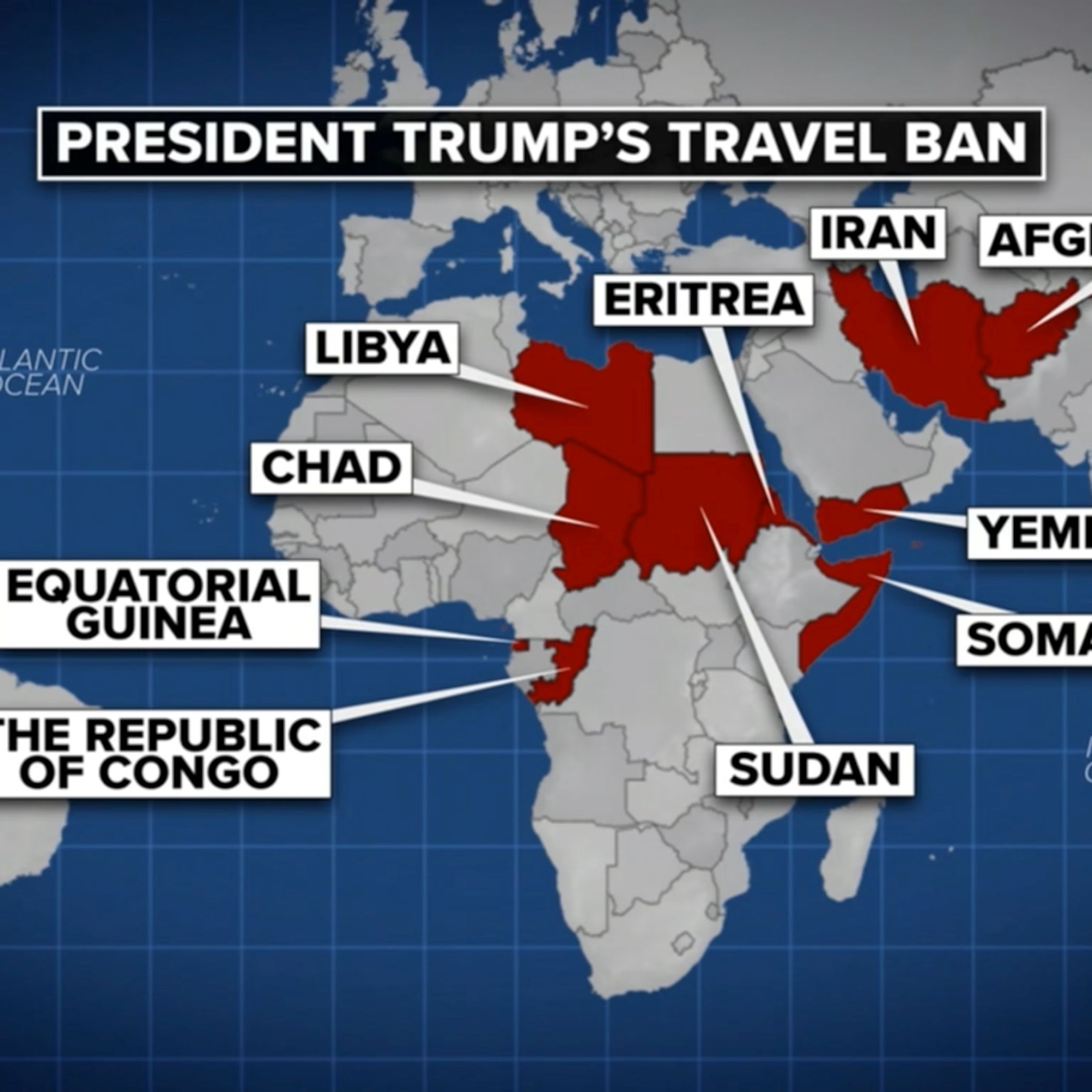
We have a controversial U.S. travel ban is drawing criticism across the globe — and confusion, especially in Central Africa. President Donald Trump, currently seeking a return to the White House, has reinstated sweeping travel restrictions targeting 19 countries. Among them: the Republic of the Congo — but not its larger neighbor, the Democratic Republic of the Congo, or DRC.
That distinction may be lost on the former president himself. During a recent meeting with Italian Prime Minister Giorgia Meloni, Trump referred vaguely to “the Congo,” claiming — without evidence — that the country had sent prisoners into the U.S. He went on to admit, quote, “I don’t know what that is, but they came from the Congo.”
The Democratic Republic of the Congo has strongly denied any such allegation. Yet the ban affects the neighboring Republic of the Congo — a different country entirely — where the White House cites a 29% visa overstay rate as justification.
Critics suggest another explanation: an ongoing negotiation between the U.S. and the DRC over a critical mineral deal. Sources familiar with the talks say that agreement may be finalized by the end of the month — potentially sparing the DRC from inclusion on the list.
Under this renewed Trump-era policy, full travel restrictions have been reimposed on a number of nations including Afghanistan, Myanmar, Chad, Eritrea, Iran, Libya, Somalia, and Yemen — along with the Republic of the Congo. Partial bans are in place for countries such as Venezuela, Cuba, and Laos.
As of tonight, the Republic of the Congo has not issued a public response. But the African Union Commission has urged the U.S. to reconsider, warning that the measures could damage long-standing diplomatic and economic ties. In a statement, the Commission emphasized the need for balanced, evidence-based decisions and appealed to the United States to act in a way that honors its historical partnership with Africa.
Venezuela was the first to publicly push back. Interior Minister Diosdado Cabello criticized the U.S. response as, quote, “fascist,” and warned his citizens against traveling to America, calling it a “great risk” for foreigners.
Somalia’s ambassador to the U.S., Dahir Hassan Abdi, also voiced concerns and called for open dialogue, saying his country values its relationship with Washington and is ready to address any issues collaboratively.
Meanwhile, as fears rise over tightening immigration policies, even America’s closest allies — including Germany, Canada, France, and the U.K. — have issued travel advisories of their own, warning their citizens to exercise caution when visiting the United States.
We will continue to monitor global reactions as this story develops.
Reporting by Ehud Jones.