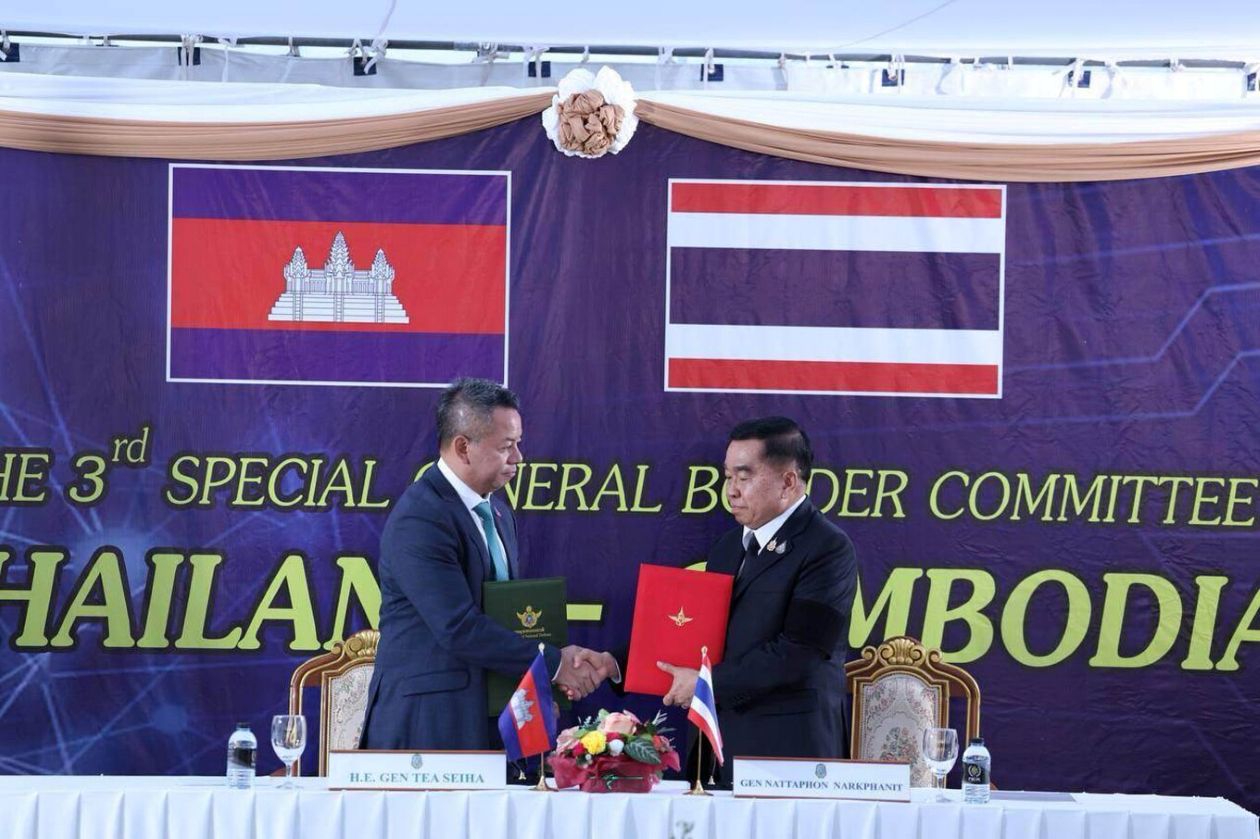
Thailand and Cambodia have signed a new ceasefire agreement aimed at ending weeks of intense fighting along their shared border, sparked by territorial disputes. The deal, which took effect at noon on Saturday, calls for an immediate halt to military movements and bans airspace violations for military purposes.
Only Thailand has conducted airstrikes recently, with strikes reported by Cambodia as late as Saturday morning, according to the Cambodian Defense Ministry.
As part of the agreement, Thailand has pledged to repatriate 18 Cambodian soldiers it has held since fighting erupted in July — a key demand from Cambodia — after the ceasefire holds for 72 hours.
However, tensions remain high. Hours after the signing, Thailand protested that a Thai soldier was permanently disabled by stepping on a land mine it accuses Cambodian forces of planting.
The pact was signed at a border checkpoint by Cambodia’s Defense Minister Tea Seiha and Thailand’s counterpart Nattaphon Narkphanit, following three days of lower-level military talks. It reaffirms commitment to an earlier ceasefire brokered in July that ended five days of fighting, and subsequent agreements.
That initial ceasefire was secured with mediation from Malaysia and pressure from then-U.S. President Donald Trump, who threatened trade sanctions if both nations did not agree. Though formalized again in October at a regional summit in Malaysia, the border dispute simmered with sporadic clashes and propaganda battles, escalating sharply in early December.
U.S. Secretary of State Marco Rubio welcomed the new ceasefire, urging both sides to fully honor the agreement and the earlier peace accords. Meanwhile, U.N. Secretary-General António Guterres praised the ceasefire as a positive step toward ending hostilities and easing civilian suffering. The United Nations also commended Malaysia, China, and the U.S. for their diplomatic efforts.
China’s Foreign Ministry hailed the ceasefire and announced upcoming trilateral talks in Yunnan, where Chinese officials aim to help both countries rebuild trust, resume dialogue, and sustain regional peace.
The fighting has taken a heavy toll on civilians and soldiers alike. Thailand has lost 26 soldiers and one civilian since December 7, with 44 civilian deaths reported. Cambodia cites 30 civilian fatalities and 90 injuries. The conflict has displaced hundreds of thousands of people on both sides.
Cambodia’s Defense Minister Tea Seiha emphasized the ceasefire’s importance in allowing displaced residents to return home, resume farming, and send their children back to school.
Both countries continue to blame each other for starting the clashes and claim self-defense.
The agreement also addresses the issue of land mines, a major concern for Thailand, which has reported multiple injuries from mines they say Cambodia planted. Cambodia counters that the mines are remnants from decades-old civil war. The new deal includes provisions for joint humanitarian mine-clearing operations to protect soldiers and civilians.
Another clause calls on both sides to stop spreading false information or fake news.
Additionally, the agreement reinstates efforts to demarcate the border and includes cooperation to combat transnational crimes — notably online scams originating in Cambodia that have defrauded victims worldwide.
Malaysia’s Prime Minister Anwar Ibrahim, instrumental in negotiating the original ceasefire, praised the new agreement, noting it reflects a shared understanding that restraint is essential to protect civilians.
However, similar provisions from previous ceasefires have only been partially respected, underscoring the fragility of the current agreement.
Thailand’s Defense Ministry spokesperson Surasant Kongsiri cautioned that the safe return of displaced civilians will be a key indicator of true stability and readiness to repatriate Cambodian prisoners. He stressed the ceasefire is a limited 72-hour test period — not an unconditional gesture — to prove Cambodia’s commitment to peace by halting hostilities and provocations.
Thailand and Cambodia agree ceasefire
We will continue to follow this developing story as efforts to secure lasting peace on the Thailand-Cambodia border unfold.
Reporting by Carl Montel.