Tesla shares took a noticeable dip today following a heated political clash between CEO Elon Musk and President Donald Trump, a dispute now drawing national attention and rattling investors.
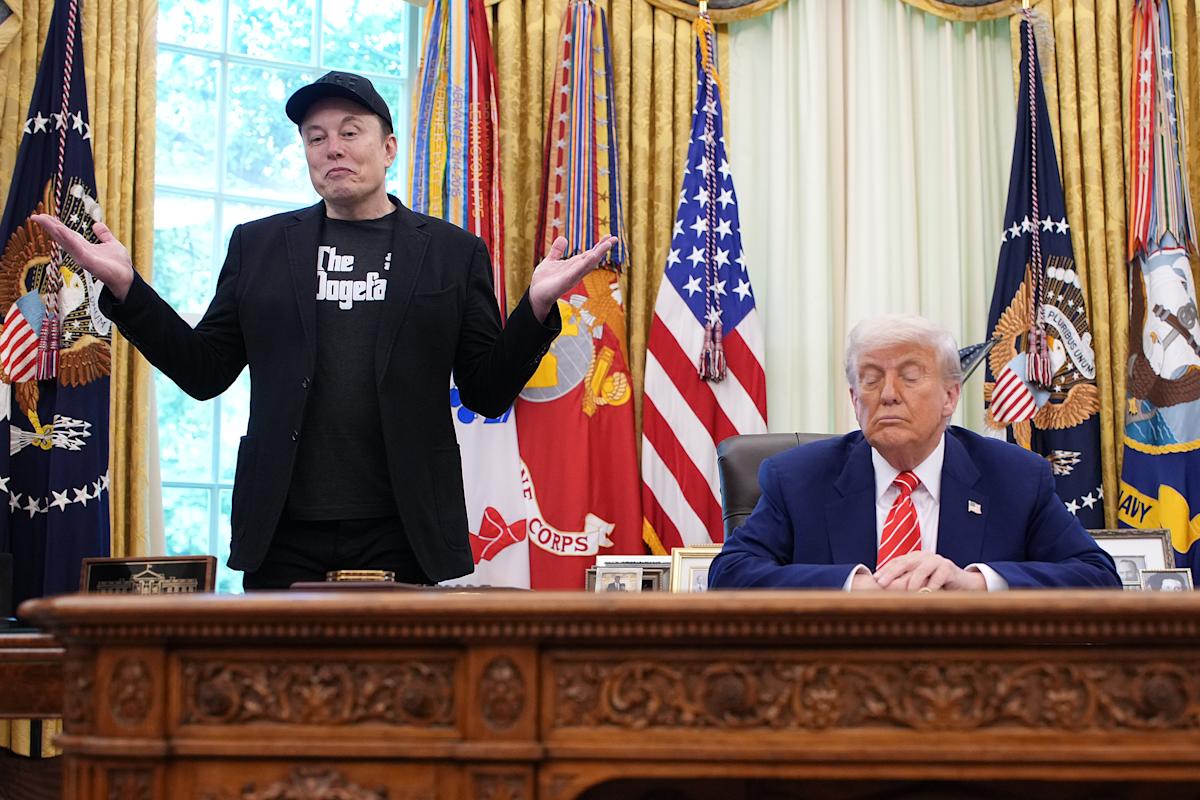
Musk, who has previously been a vocal supporter of Trump, turned sharply against a major Republican-backed spending bill, dubbing it, quote, “a disgusting abomination.” The Tesla and SpaceX chief took to his platform, X, formerly Twitter, launching a fiery call to action, urging Americans to contact their lawmakers and, in his words, “KILL the BILL.”
Musk warned that continued government overspending would eventually hollow out the U.S. budget, leaving only enough to pay off interest on the national debt. His criticism comes as the Congressional Budget Office projects that the legislation could inflate the deficit by a staggering $2.4 trillion over the next decade.
The bill, once praised by Trump as “big” and “beautiful,” now faces growing pushback not only from Democrats but from one of the tech world’s most powerful voices.
Musk’s outrage has also reignited scrutiny over the Department of Government Efficiency or DOGE, a cost-cutting agency he once led. While the department promised sweeping budget reductions, critics argue it has failed to deliver meaningful savings and has introduced widely unpopular measures.
The political backlash is starting to bleed into Tesla’s business. Once seen as a beneficiary of Musk’s close ties to Washington, the electric vehicle giant is now facing weakening demand in several global markets, fueled in part by Musk’s increasingly polarizing political persona.
Protests have erupted outside Tesla showrooms in the U.S., while some longtime Tesla owners report feeling alienated by Musk’s hard-right positions, especially his continued backing of Trump and his stint at DOGE.
Adding to the turbulence is Tesla’s high-stakes robotaxi launch, scheduled for June 12 in Austin, Texas. The test marks a critical juncture for the company, as its long-term valuation hinges on successfully unlocking autonomous driving technology.
But Tesla faces stiff competition. Alphabet’s Waymo continues to dominate the robotaxi space, reporting 250,000 rides per week, a figure Tesla has yet to approach.
Meanwhile, the company’s core vehicle sales have presented a mixed picture. While May saw Tesla’s highest delivery total in nearly a year in Australia driven largely by a surge in Model Y purchases, broader global sales continue to struggle.
In the UK, Tesla registrations plunged 45% in May, even as the overall car market grew. Chinese rival BYD more than doubled its sales in the UK, signaling increasing competition. Across Europe, Tesla sales slumped in key markets like France, Germany, and Spain, though there were modest gains in Austria and Norway.
Despite headwinds, Tesla remains the leading EV brand in Australia, and some analysts are cautiously optimistic about a rebound, especially if Model Y’s momentum holds.
Still, between falling international sales, mounting political backlash, and intensifying competition in autonomous vehicles, the pressure is on Tesla and its outspoken CEO to recalibrate their approach and quickly.
We will continue tracking the fallout from this political and financial firestorm.
Reporting by Katy Moore.