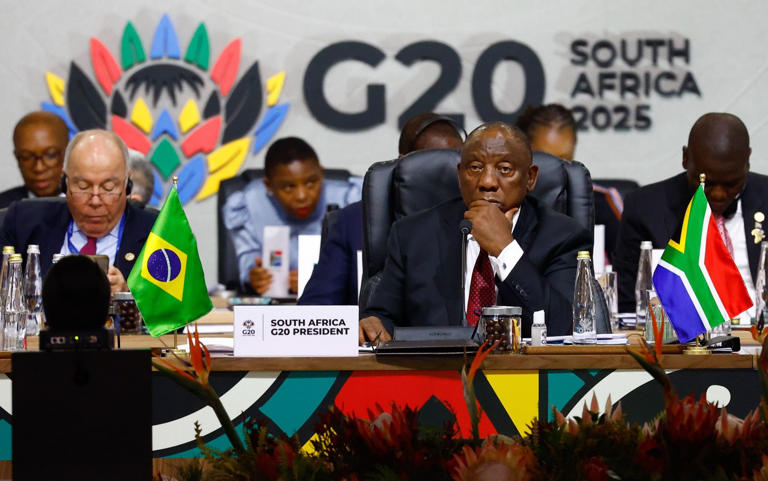
The recent G20 summit hosted by South Africa ended before it really began, overshadowed by diplomatic tensions and the absence of key leaders like US President Donald Trump and Argentina’s Javier Milei.
South Africa’s presidency of the G20 has been marked by controversy. The country is currently leading a genocide case against Israel at the International Court of Justice—a move that many found divisive. Earlier this year, President Trump confronted South African President Cyril Ramaphosa over allegations that white farmers in South Africa were being subjected to violent land seizures and killings, accusations Ramaphosa denied.
This summit followed a troubling chain of events: after the devastating Hamas attacks on Israel in October 2023, South Africa’s foreign minister quickly engaged with Hamas leaders and traveled to Iran. By the end of 2024, Pretoria had lodged a genocide case against Israel, further fueling international tensions. South Africa has a history of supporting Hamas, having signed a letter of intent with the group back in 2015.
Many G20 members are now facing the reality of South Africa’s aggressive pursuit against Israel, which has amplified controversial narratives and redefined the term “genocide.” It’s important to clarify: genocide refers to the systematic extermination of entire ethnic or religious groups, as seen historically with the Holocaust or Rwanda—not wars between armed forces. Hamas, unlike defenseless civilian populations in those tragedies, is a militant group responsible for ongoing attacks against Israel, including the mass killing and kidnapping of civilians on October 7, 2023.
Israel’s military response has aimed to protect its citizens and dismantle Hamas’s military capabilities. Unfortunately, Hamas’s use of civilian infrastructure and tactics—such as firing rockets from hospitals, schools, and residential areas—has made it impossible to avoid civilian casualties, as Gaza’s population has tragically suffered the consequences.
Israel has taken steps to minimize harm, creating humanitarian corridors, issuing warnings, and facilitating massive aid deliveries and vaccination campaigns in Gaza, actions exceeding standard international legal requirements.
The genocide claim, heavily promoted by Hamas and supported by South Africa, has been a key part of a global political campaign to sway international opinion, often ignoring the role Hamas has played in the ongoing conflict.
G20 leaders must hold Hamas and other terrorist groups responsible for the devastation in Gaza. Hamas’s strategy has consistently disregarded civilian lives, manipulating global narratives while waging a war of terror.
This revival of anti-Semitic accusations against Israel echoes long-standing prejudices that should be firmly rejected by the international community. Instead, the focus should be on ending Hamas’s influence in Gaza and fostering stability and prosperity in the region.
South Africa’s controversial stance, combined with the absence of influential leaders like President Trump, highlighted the challenges facing this year’s G20 summit and raised serious questions about its effectiveness.
That’s the latest from the G20 summit.
Reported by Carl Montel