Pakistan has officially confirmed that its nuclear capabilities could be made available to Saudi Arabia under a newly signed defense agreement, marking a significant development in Gulf security amid ongoing regional tensions.
Defense Minister Khawaja Mohammad Asif revealed in a Geo TV interview late Thursday that Pakistan’s nuclear arsenal, long-established and maintained with trained forces, “will be made available” to Saudi Arabia if needed, in line with the countries’ recently signed mutual defense pact. This is the first public acknowledgment that Islamabad has effectively placed Riyadh under its nuclear umbrella.
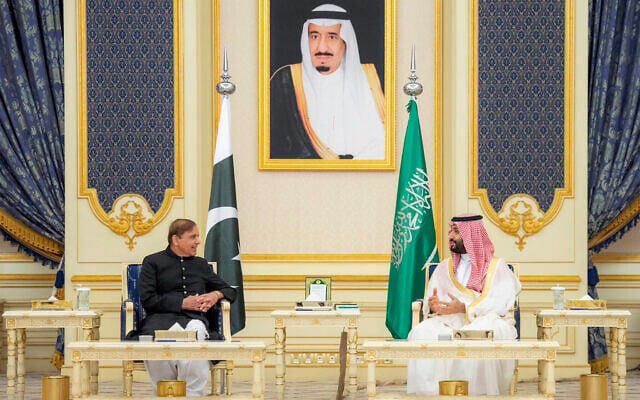
The deal, signed Wednesday, stipulates that an attack on one nation would be treated as an attack on both. Officials emphasized that while neither Pakistan nor Saudi Arabia has named any potential aggressor, both sides have committed to joint defense should either come under attack.
Asif’s comments come amid heightened concerns across the Gulf following Israel’s deadly strike on Hamas leaders in Qatar last week, which killed six people and reignited fears for regional security. Analysts note that Pakistan’s nuclear pledge signals a deterrent to Israel, widely regarded as the Middle East’s only confirmed nuclear power.
During the interview, Asif criticized Israel for its opaque nuclear program, noting that the country is not a signatory to the Treaty on the Non-Proliferation of Nuclear Weapons and maintains a policy of deliberate ambiguity regarding its arsenal.
Saudi Arabia and Pakistan have maintained military and strategic ties for decades, with Saudi financial support historically aiding Pakistan’s nuclear and missile programs, especially during periods of international sanctions. Pakistan’s ballistic missile capabilities, including the Shaheen-3 missile capable of carrying nuclear warheads over distances up to 2,750 kilometers, are widely considered capable of reaching Israel.
Deputy Prime Minister Ishaq Dar added that the defense pact’s door is not closed to other nations. “Other countries have expressed interest in similar arrangements,” he said, while emphasizing that such agreements follow a formal process and require careful negotiation, as was the case with Saudi Arabia.
The announcement underscores mounting security concerns in the region. Since October 7, 2023, the Israel-Hamas conflict has sparked missile exchanges and military confrontations across Gaza, Lebanon, Yemen, Syria, and Iran. The new Pakistan-Saudi defense pact is widely seen as a precautionary measure in response to these developments and a signal of unity among Gulf allies.
This landmark agreement also follows the recent military escalation between India and Pakistan earlier this year, further highlighting Islamabad’s commitment to bolstering its strategic deterrence in the region.
While Pakistan and Saudi Arabia continue to deny targeting any specific nation, the move marks a major shift in regional defense dynamics and reaffirms their decades-long partnership amid heightened Middle East tensions.
Reporting by Carl Montel.