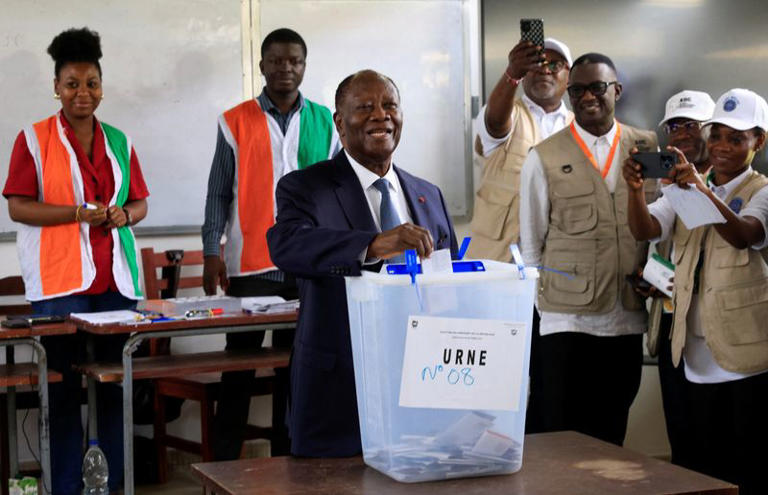
In West Africa, Ivory Coast’s longtime leader, Alassane Ouattara, has been confirmed as the winner of the country’s presidential election — securing a fourth term in office with an overwhelming margin. The victory extends his decade-long rule but also reignites questions about democratic competition and political renewal.
According to provisional results released Monday, the 83-year-old president won nearly 90 percent of the vote — a landslide that came as little surprise after his main challengers were barred from running. The country’s electoral commission said turnout was about 50 percent — far below the record 80 percent participation seen in 2010.
Ouattara, a former international banker and IMF executive, first came to power in 2011 after a disputed election that triggered a civil war leaving some 3,000 people dead.
Since then, he’s been credited with restoring stability and driving strong economic growth in the world’s top cocoa producer.
His closest rivals in this election — former Commerce Minister Jean-Louis Billon and former First Lady Simone Gbagbo — received just over 3 and 2 percent of the vote respectively.
Despite the one-sided results, Gbagbo reportedly called Ouattara to congratulate him on his victory. But not everyone was convinced the vote was fair.
CITIZEN : “There was no point in voting. Everything was arranged for Ouattara to win.”
The campaign period saw scattered protests in several cities, including Yamoussoukro, prompting curfews and a heavy security presence.
Authorities deployed 44,000 security personnel, and Amnesty International criticized what it called a disproportionate ban on demonstrations.
Hundreds were arrested, with dozens reportedly sentenced to prison terms for public order offenses.
In his victory remarks, Ouattara said his new term would focus on expanding private investment and preparing a new generation of leaders to take over the reins of power.
But analysts warn that without a clear successor, the nation could once again face internal divisions when Ouattara eventually steps down.
RINALDO DIPAGNE : “If he fails to appoint a successor, the country could risk repeating the instability that followed the death of its first president, Félix Houphouët-Boigny.”
The Constitutional Council is expected to confirm the results in the coming days, formalizing Ouattara’s continued leadership.
For many Ivorians, the question now is whether the president’s next term will deliver on promises of renewal — or deepen the sense of political fatigue that has gripped the nation.
Reporting by Ehud Jones.