A dramatic and controversial shift in U.S. foreign policy — one that is sending shockwaves through diplomatic circles around the world. Just days ago, Syria’s president, Ahmed al-Sharaa, was officially listed by the United States as a specially designated global terrorist. Tonight, he has done something no Syrian leader has ever done before — he has walked into the White House and met the President of the United States.
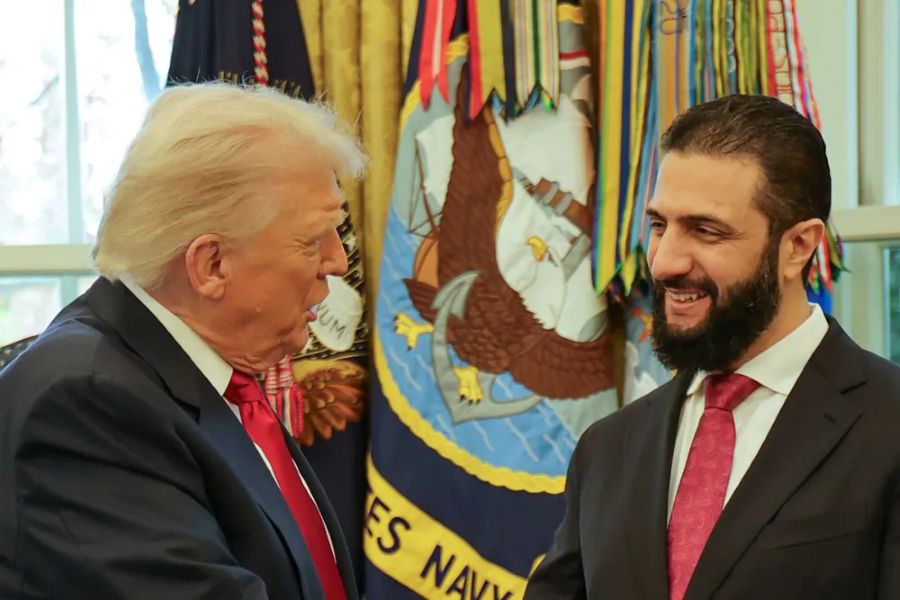
On Monday, al-Sharaa became the first Syrian president to enter the Oval Office, marking an extraordinary reversal in Washington’s stance. Until recently, the man now shaking hands with President Donald Trump had a ten-million-dollar U.S. bounty on his head, a reward that was only lifted late last year.
The meeting itself was highly unusual — and tightly controlled.
Unlike traditional state visits, al-Sharaa was quietly ushered into the White House through West Executive Avenue, away from cameras and reporters. He did not arrive through the front entrance of the West Wing, a detail that underscores how sensitive — and controversial — this encounter remains.
Two hours later, al-Sharaa exited the White House to cheers from a group of supporters, marking a surreal moment for a man once synonymous with global jihad.
To understand the magnitude of this moment, consider al-Sharaa’s past.
He once pledged allegiance to al-Qaeda, modeled himself after Osama bin Laden, and led militant operations in Syria and Iraq that included the use of suicide bombers. His transformation from militant commander to head of state — and now a White House guest — is almost without precedent.
This was not the first time President Trump met al-Sharaa.
The two first encountered one another in May at a regional summit in Saudi Arabia, where President Trump publicly described him as a “tough guy” with a “very strong past” — notable language for someone the U.S. government itself had labeled a terrorist.
Following Monday’s Oval Office meeting, President Trump went even further, calling al-Sharaa a “very strong leader” and signaling Washington’s willingness to support Syria’s future.
But experts urge caution.
One former Western diplomat described the move as a “colossal gamble,” warning that al-Sharaa could either become a strategic partner — or a dangerous adversary operating under a new image.
Supporters point to what they describe as al-Sharaa’s gradual evolution over the past five years. Once known for banning Christian holidays and persecuting minorities, he has since apologized to religious leaders, returned confiscated property, and made public gestures toward reconciliation.
Sources say that, at Turkey’s request, al-Sharaa also began cooperating with international intelligence agencies, including the CIA and Britain’s MI6. He reportedly detained jihadist figures linked to Europe and even assisted indirectly in operations targeting ISIS leadership.
Still, analysts warn that these actions may reflect pragmatism rather than ideology — a leader acting in his own interests as Syria seeks legitimacy, stability, and economic survival.
For President Trump, however, the calculation appears clear.
In a region where old alliances have fractured and diplomacy is scarce, the administration seems willing to take a risk — betting that engagement, rather than isolation, may finally change Syria’s trajectory.
Whether this gamble leads to peace or regret remains to be seen.
For now, one thing is certain: the rules of engagement in the Middle East are being rewritten — live from the Oval Office.
Reported by Carl Montel.