After months of war and an uneasy ceasefire, Hamas is reasserting control across the Gaza Strip — and doing so with force. Reports from Gaza describe public executions, raids on rival militias and a campaign to bring autonomous clans under its authority. Our top story tonight: what this means for Gaza’s future, and for the fragile political talks that lie ahead.
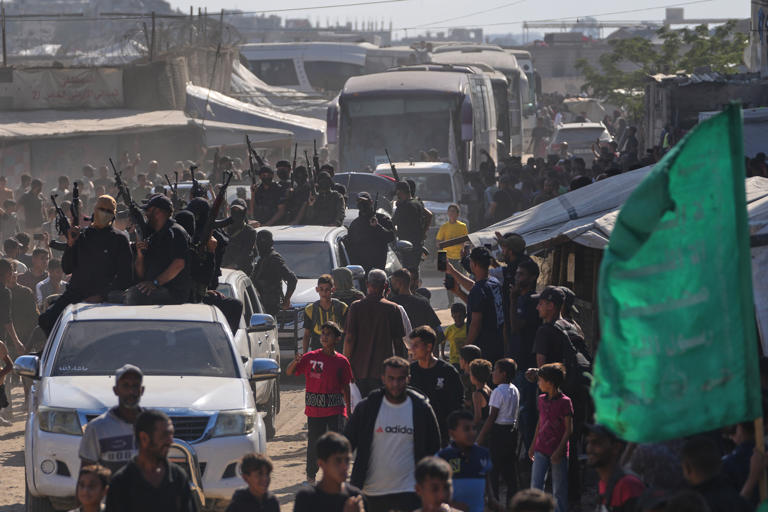
In Gaza City, masked fighters publicly executed men accused of collaborating with Israel. Elsewhere, Hamas dispatched jeeps and armed units to chase down factions it says coordinated with Israeli forces — including the Astal militia and members of the Mujaida and Doghmush families. Rival leaders and analysts say these moves are meant to send a clear message: Hamas intends to be the only visible authority left on Gaza’s streets.
The crackdown has included house-to-house raids, targeted strikes on clan strongholds, and the formation of special units — like the so-called “Sahem” — tasked with hunting looters, arms traffickers and those who allegedly collaborated with Israel. Hamas officials portray the campaign as law enforcement meant to restore order after the chaos of war; some Gaza residents and local councils have publicly backed efforts to stop looting and violence.
But critics and militia leaders warn the violence could spiral into internal conflict — possibly a wider civil war — pitting armed families and locally backed gangs against Hamas. Several influential clans, some of whom reportedly received covert Israeli support during the fighting, say they were attacked preemptively and forced to choose between resistance or submission.
One clan leader described Hamas’s tactics as methodical and long planned — citing documents and battlefield evidence he says were taken from dead fighters. In one reported clash, roughly 100 gunmen in Hamas uniform advanced on a neighborhood, sparking intense fighting that only stopped after an Israeli strike. Many local leaders say the group’s operations combined intelligence, coordination and a willingness to target rival families publicly.
Hamas’s internal security units have circulated statements promising mercy to those who return to the national fold, while also warning that reprisals will continue against those it deems criminals or collaborators. Videos posted by Hamas show gunmen directing traffic and men in uniform exercising day-to-day control — signaling a return to governance, at least in the areas it holds.
The shift has major implications for upcoming negotiations over Gaza’s future. Under the ceasefire framework and international mediation, questions remain about disarmament and who will govern Gaza. Hamas publicly says it can hand over governance, but privately negotiators say the group is pushing to retain a role — perhaps rebranded as a political movement — and to keep light arms for personal protection in a society fractured by clans and militias.
Analysts say Hamas’s recent actions strengthen its bargaining position. By reestablishing order — however violently — the group argues it is indispensable to stability in Gaza and therefore should have influence in any post-ceasefire arrangement. Mediators worry the consolidation of power could complicate efforts to disarm armed groups and to build inclusive civilian governance.
Some observers fear the internecine violence could be protracted. Critics also warn that the fragmentation of authority in Gaza — and the prospect of more fighting between clans and Hamas — may further divide Palestinian society and undermine reconstruction and humanitarian efforts.
For now, Hamas appears to be prioritizing internal consolidation: appointing new governors, reestablishing administrative functions in bombed-out neighborhoods, and using force to deter rivals. Whether that consolidation leads to a stable post-war order — or to long-term cycles of reprisal and counterattack — remains the central question for Gaza’s future.
Reporting by Carl Montel.