
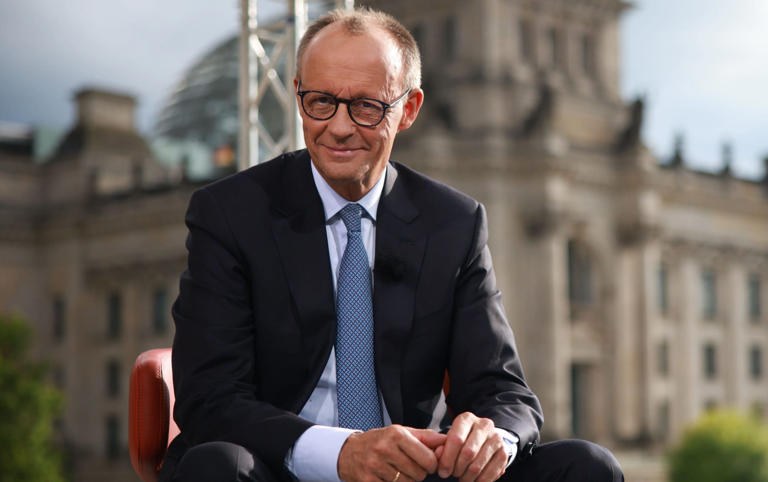
Germany’s Chancellor Friedrich Merz has issued a stark warning about the future of his country’s welfare system, declaring it financially unsustainable in its current form. Speaking at a state-level party conference on Saturday, Merz argued for a fundamental reassessment of benefits, as social spending surges beyond last year’s record of 47 billion euros.
“The welfare state as we have it today can no longer be financed with what we can economically afford,” Merz told delegates.
His comments come as Germany faces mounting economic challenges. Once hailed as Europe’s export powerhouse, growth has slowed dramatically. Since 2017, German GDP has risen only 1.6 percent, compared to 9.5 percent across the eurozone. The economy contracted in both 2023 and 2024, the first two-year decline since the early 2000s. In the second quarter of this year, GDP slipped again by 0.3 percent. Industrial production, already under strain during the Scholz coalition years, continues to falter.
Meanwhile, welfare costs are climbing rapidly. With an aging population and rising unemployment, spending on pensions and benefits is consuming a larger share of the national budget. According to Eurostat, state pensions in Germany account for roughly 12 percent of GDP, with additional family and child benefits adding more than 3 percent.
While Merz’s warning has drawn comparisons with Britain, Germany’s debt burden remains relatively low. At 62.5 percent of GDP, it is well below the UK’s 96.3 percent, one of the highest among developed nations. Still, both countries are grappling with rising costs of social programs. In Britain, welfare spending already consumes about 11 percent of GDP, with pensions projected to climb from 159 billion pounds this year to 182 billion by 2030. Disability benefits in the UK are also surging, forecast to jump more than 50 percent in the next six years.
Germany, however, operates under a constitutional “debt brake,” limiting government borrowing and adding pressure to control social spending.
The Chancellor’s message underscores a broader concern across Europe: how to balance social protections with economic realities in an era of slowing growth and rising costs.
Reporting by Lisa Lomami.