In a major legal development, a second federal court has now blocked former President Donald Trump’s birthright citizenship executive order from taking effect anywhere in the United States. This ruling follows a recent Supreme Court decision that sought to limit the reach of nationwide injunctions—yet left room for exceptions under specific circumstances.
The 9th U.S. Circuit Court of Appeals issued a 2–1 decision on Wednesday siding with four Democratic-led states Washington, Arizona, Illinois, and Oregon—who argued that anything less than a nationwide block would fail to protect their residents.
Judge Ronald Gould, writing for the majority, emphasized that people affected by the order could move between states, undermining any geographically limited relief. His opinion was joined by Judge Michael Hawkins; both were appointed by former President Bill Clinton.
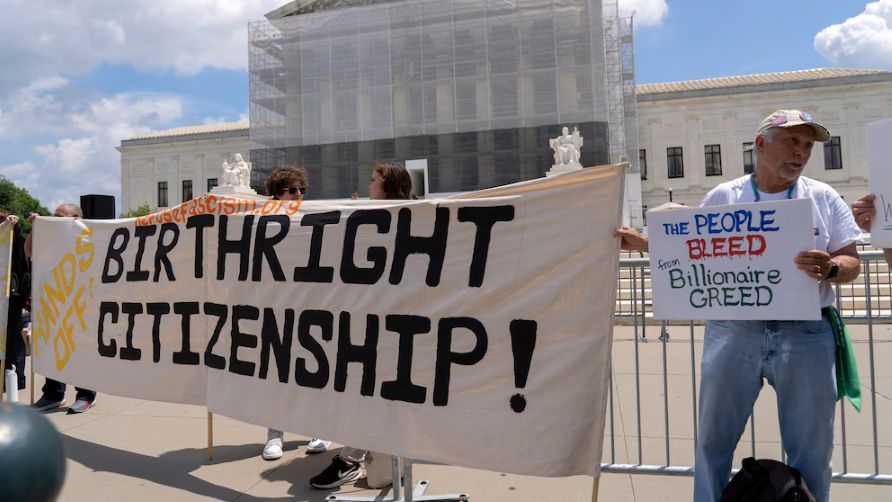
The controversial executive order, issued during Trump’s second term, would deny U.S. citizenship to babies born on American soil if neither parent holds permanent legal status—a direct challenge to the 14th Amendment’s long-standing guarantee of birthright citizenship.
So far, every court that has reviewed the order has deemed it unconstitutional.
In his dissent, Judge Patrick Bumatay, a Trump appointee, argued the case should have been thrown out. He warned that courts must not overreach, especially in politically sensitive matters.
“We risk entangling ourselves in contentious issues not properly before us,” he wrote, adding that courts must always stay within “the judicial power” defined by the Constitution.
This case follows a 6–3 Supreme Court ruling last month, which limited lower courts’ ability to issue nationwide injunctions. However, the justices also clarified that class actions and state lawsuits could still result in universal relief if that’s the only way to fully resolve the harm. States, the high court said, can obtain broad injunctions when comprehensive relief is otherwise impossible.
Indeed, this is now the second such block since the Supreme Court’s ruling. Earlier this month, a federal judge in New Hampshire granted the ACLU’s request to certify a nationwide class of unborn children, halting enforcement of the policy nationwide.
Judge Gould explained that a partial injunction would force states to rebuild eligibility systems for critical programs like Medicaid, CHIP, and Title IV-E child welfare services—a burden the court found both costly and harmful.
“The states would suffer the same irreparable harms under a geographically-limited injunction as they would without one,” Gould concluded.
Tonight’s decision underscores the ongoing legal and constitutional battles over immigration policy and presidential power. With multiple courts now striking down Trump’s birthright citizenship order—and more lawsuits still pending—it appears this issue is far from over.
We will continue following all developments closely.
Reporting by Katy Moore.