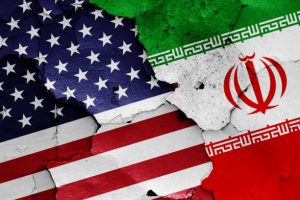
As the world ushered in the new year of 2026, an unexpected geopolitical shock rattled the international stage — the sudden U.S. military strike in Venezuela and the capture of longtime Venezuelan leader Nicolás Maduro. This event has sent ripples far beyond Latin America, directly impacting Iran’s global alliances and strategic positioning.
Overnight, surprise strikes on Caracas took many off guard. Meanwhile, social media buzzed with speculation, even noting a spike in Pentagon pizza orders as an informal sign of impending U.S. action. But this was no isolated incident. Instead, it signals a coordinated U.S. push affecting multiple regions — from Venezuela to Nigeria, where military operations against militants unfolded, and of course Iran, which remains at the center of Washington’s strategic concerns.
President Donald Trump wasted no time sending strong messages toward Tehran, reaffirming his administration’s tough stance. Venezuela, Nigeria, and Iran share a key link as major oil producers, raising questions among experts about whether the U.S. is positioning itself to reshape global energy dynamics — including influence within OPEC.
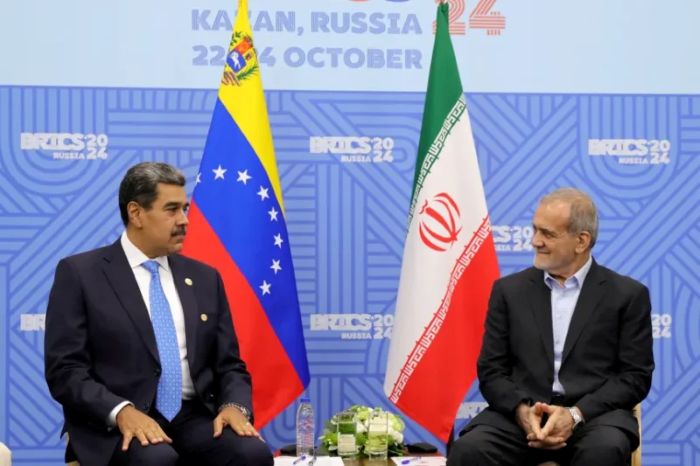
Despite the upheaval, Venezuela’s critical oil infrastructure appears intact, with officials assuring that production and refining continue uninterrupted. However, the political fallout of Maduro’s fall is deeply significant for Tehran. For years, Venezuela has been one of Iran’s closest international partners, collaborating extensively on economic, oil, and security fronts. These ties, forged initially under former Iranian President Mahmoud Ahmadinejad and late Venezuelan President Hugo Chávez, were grounded in ideological affinity and mutual opposition to the U.S.
Now, with Maduro deposed, the future of Iranian investments and financial interests in Venezuela hangs in the balance, even as Iran itself faces a severe economic crisis marked by foreign exchange shortages.
This international turmoil coincides with widespread protests inside Iran, fueled by a deepening economic crisis and collapsing public confidence. These demonstrations have extended to cities across the country, echoing frustrations over inflation, declining purchasing power, and perceived systemic corruption — a social divide widening between everyday citizens and the political elite.
Iran’s Supreme Leader, Ayatollah Ali Khamenei, has reiterated his hardline stance, distinguishing between legitimate protesters and “agitators,” warning that attempts to destabilize the regime will not be tolerated. His statements, delivered shortly after Maduro’s fall, underscore the gravity with which Tehran views these parallel domestic and international challenges.
Looking beyond Tehran, analysts are also scrutinizing Russia’s role as a regional power broker. Both Syria and Venezuela — longtime Russian allies — have experienced sudden political upheaval despite Moscow’s support. This raises questions about whether Russia’s strategic commitments are as steadfast as assumed, particularly in light of its cautious diplomacy during Iran’s recent 12-day conflict and broader geopolitical maneuvers.
While Iran remains reliant on Russia for military, nuclear, and economic cooperation, this relationship is viewed more as a pragmatic partnership born of necessity rather than loyalty, marked by mutual coercion and shifting priorities.
Domestically, Iran’s economy is under intense pressure from sanctions, soaring inflation, and a steep decline in living standards. Many Iranians view government promises of reform as inadequate and delayed, fueling discontent and skepticism.
The collapse of allied governments like those in Syria and Venezuela sends a stark signal to Tehran: longstanding partnerships may be vulnerable to global power shifts and strategic recalibrations. Whether these changes reflect purely internal dynamics or a larger geopolitical realignment remains to be seen.
What is clear is that Iran faces a complex crossroads — a convergence of external pressures, internal unrest, and the fracturing of key alliances — presenting one of the most challenging political and economic junctures in recent memory.
For Iranian society, this moment is deeply paradoxical: a collective memory shaped by war and sanctions, yet a present burdened by ineffective governance and social division. This volatile mix has eroded traditional crisis management tools and heightened the risk of further instability.
In this sense, the recent economic protests are not just reactions to rising prices but symptoms of a long-simmering structural crisis. As instability brews from Caracas to Tehran, the fate of these nations seems increasingly intertwined — a reminder of the fragile nature of political alliances and the shifting tides of global power.
Reporting by Carl Montel.