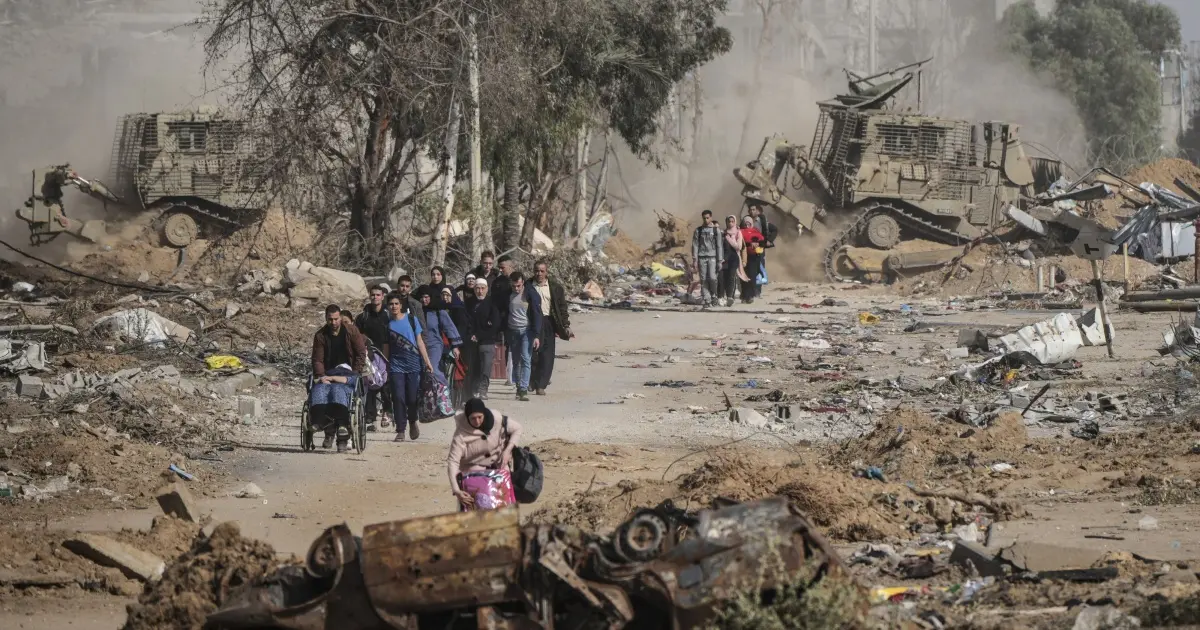
Today, international frustration mounts as the world watches the escalating humanitarian crisis in Gaza, with efforts to rein in Israel’s military campaign proving largely ineffective.
Vatican Outcry After Church Bombing
Pope Leo XIV issued a solemn plea from the Vatican on Thursday, calling for an “immediate ceasefire” in the Gaza Strip. This heartfelt appeal followed a devastating Israeli airstrike that hit Gaza’s only Catholic Church, killing three civilians who had sought shelter inside and injuring ten others. Israeli officials blamed the incident on “stray ammunition.”
The pontiff lamented the growing toll on Gaza’s Christian minority and emphasized the urgent need for “dialogue and reconciliation” as ceasefire talks between Israel, Hamas, and regional mediators continue—but with little sign of progress.
Israel’s Military Expands Operations into Syria
Meanwhile, Israel’s campaign stretches beyond Gaza. Airstrikes this week struck targets in Syria, which Israeli officials claim were aimed at protecting the country’s minority Druze population from sectarian violence. However, analysts say the strikes are part of a broader strategy to maintain Israel’s influence in the region amid Syria’s fragile post-war transition.
ICC Rejects Israel’s Request to Halt Arrest Warrants
At The Hague, the International Criminal Court dealt a blow to Israel’s legal defense. Judges there refused to revoke arrest warrants for Israeli Prime Minister Benjamin Netanyahu and former defense chief Yoav Gallant, both wanted for alleged war crimes in the aftermath of Hamas’s October 7th attack on southern Israel.
In retaliation, the United States imposed sanctions on several ICC judges and prosecutors—a move seen as an attempt to shield its ally from international legal scrutiny.
EU Pressure Eases on Israel—But Not Without Criticism
Israeli foreign minister Gideon Saar returned from Brussels this week declaring a diplomatic victory. He claimed success in persuading the European Union to hold off on punitive sanctions against Israel. EU Foreign Policy Chief Kaja Kallas confirmed that while “options remain on the table,” the bloc would not proceed with penalties just yet.
Saar characterized the attempted sanctions as an unjust attack on a democratic nation defending itself. But human rights groups reacted sharply. Amnesty International’s Agnès Callamard labeled the EU’s stance “a disgraceful moment in its history,” condemning the decision as a betrayal of human rights and humanitarian law.
Dissent from Within the EU Bloc
Still, not all European governments are toeing the line. Ireland, Spain, and Slovenia have emerged as vocal critics of Israel’s conduct in Gaza.
-
Spanish Prime Minister Pedro Sánchez recently accused Israel of committing genocide.
-
Ireland is advancing legislation to ban trade with Israeli settlements in the occupied West Bank.
-
Slovenia declared two far-right Israeli ministers persona non grata, banning them from entry.
“This is a first for the EU,” said Slovenian Foreign Minister Tanja Fajon. “We are breaking new ground.”
But larger powers such as Britain, France, and Germany remain hesitant to take similar steps, while efforts by French President Emmanuel Macron to revive peace talks appear to be fading.
Global South Steps In – The Bogotá Summit
Far from the power corridors of Europe, a summit in Bogotá this week gathered delegates from over 30 countries seeking to pressure Israel into ending its war and occupation. The conference—co-hosted by Colombia and South Africa, the latter currently leading a genocide case against Israel—resulted in 12 nations agreeing on measures to “restrain” Israel. These include:
-
An arms embargo
-
A ban on military shipments
-
Reviews of contracts with companies linked to Israel’s occupation
Signatories included Bolivia, Indonesia, Malaysia, Iraq, and several others. While these countries may not shift global military balances, analysts say this could mark the rise of a new multilateral movement challenging U.S.-led diplomacy.
“This is more than just Israel and Palestine,” said Annelle Sheline, a former U.S. State Department official. “This is a reshaping of the global order.”
A Battle of Wills—And Narratives
As Israel defends its actions as necessary to defeat terrorism, its critics argue the cost to Palestinian civilians is too high. With tens of thousands dead and Gaza in ruins, the tension between self-defense and humanitarian accountability is testing global alliances and diplomatic resolve.
As it stands, the world watches with growing unease—and limited power to change the course.
Reporting by Carl Montel.