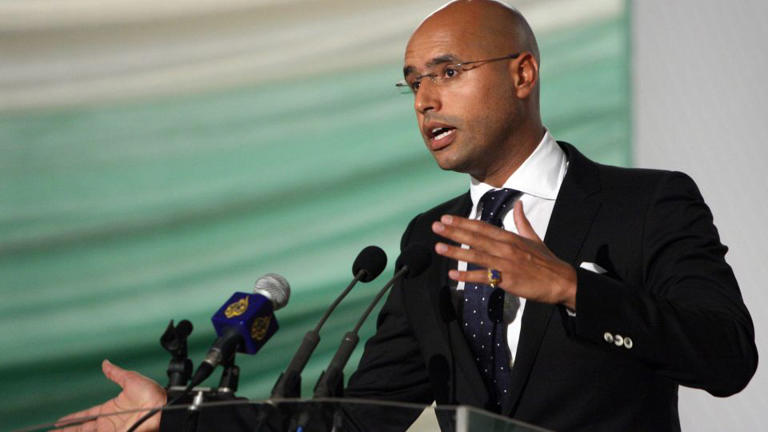
Saif al-Islam Gadhafi, the son of Libya’s former ruler Moammar Gadhafi, has been killed in a violent attack at his home in the northwestern city of Zintan, his political team confirmed Tuesday. He was 53 years old.
Once regarded as the heir apparent to his father’s regime, Saif al-Islam had been attempting a political comeback in recent years amid Libya’s ongoing turmoil. According to his political advisor Abdullah Othman, four masked gunmen stormed his residence, disabled security cameras, and fatally shot him in what was described as a “treacherous and cowardly” assassination.
So far, Libyan authorities have not issued an official statement, and the International Criminal Court, which had long sought Saif al-Islam’s arrest on charges of crimes against humanity, has yet to comment.
Born in Tripoli in 1972, Saif al-Islam was the second son of Moammar Gadhafi, who ruled Libya for over four decades before being ousted and killed during the Arab Spring uprising in 2011.
During the early days of the 2011 protests, Saif al-Islam made a televised address warning of civil war and chaos if demonstrations continued—signaling his break from earlier reformist rhetoric and aligning himself with his father’s hardline crackdown. Later that year, the ICC issued arrest warrants for both father and son on charges linked to the violent suppression of the revolt.
After fleeing Tripoli, Saif al-Islam was captured months later by a militia in Zintan and held until a controversial 2017 amnesty led to his release.
He resurfaced politically in 2021, registering to run in Libya’s postponed presidential elections. His candidacy polarized the country—while some viewed him as a potential stabilizing force, many others saw him as a symbol of the country’s troubled past and unaddressed war crimes.
In recent months, Saif al-Islam reportedly had been working on a proposal aimed at national reconciliation, a source close to him told international media.
In response to his death, Saif al-Islam’s political team has called on Libya’s judiciary, the United Nations, the international community, and human rights organizations to conduct a thorough, independent investigation to bring those responsible to justice.
As Libya continues to grapple with instability, the assassination marks a dramatic and tragic turn in the country’s fraught political landscape.
Reporting by Ehud Jones.