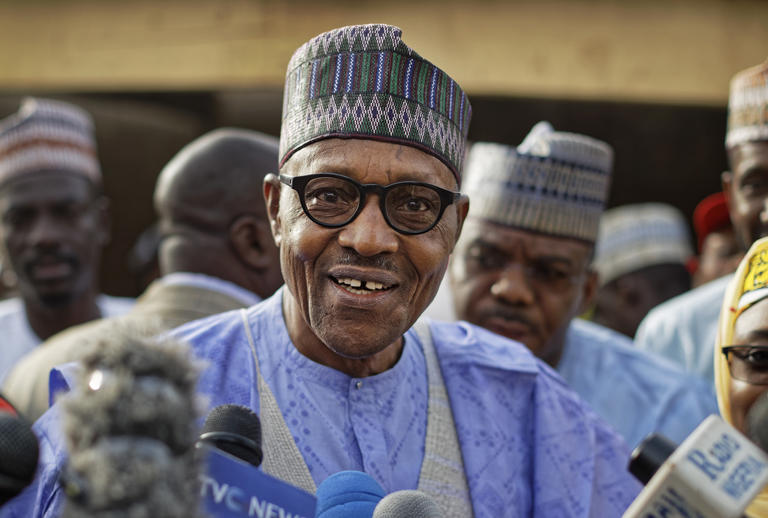
We have breaking news out of West Africa. Former Nigerian President Muhammadu Buhari a towering figure in the nation’s modern history has died at the age of 82.
Buhari passed away Sunday in London, according to a statement from his press secretary. He had reportedly been receiving medical care in the British capital, where he had spent extended periods during his presidency.
Buhari’s political legacy is as complex as it is consequential. He was twice Nigeria’s leader, first as a military ruler in the early 1980s, then decades later as a democratically elected president.
In 1983, Buhari seized power in a military coup, ushering in a brief but authoritarian regime known for its rigid discipline and harsh enforcement policies. His government cracked down on dissent, detained critics, and launched a controversial anti-corruption campaign. But he was ousted by fellow officers in under two years.
Then in 2015, in a historic electoral victory, Buhari returned to the national stage, this time at the ballot box. He became the first opposition candidate in Nigeria’s history to defeat a sitting president, propelled by promises to end rampant corruption and restore security.
During his two-term presidency, Buhari oversaw both triumphs and turbulence. He celebrated a major win when dozens of schoolgirls abducted by Boko Haram in 2014 were freed. He also claimed credit for driving the extremist group out of key strongholds in Nigeria’s northeast.
But deadly suicide bombings and persistent attacks revealed that the insurgency was far from over. A tragic misstep in 2017 saw the Nigerian military mistakenly bomb a camp for displaced persons, killing over 100 civilians, in an incident the United Nations described as “truly catastrophic.”
On the home front, Buhari’s leadership was deeply polarizing. In 2020, a national uprising by youth under the #EndSARS banner protesting police brutality was met with deadly force. Soldiers opened fire on demonstrators, sparking international outrage. Civil society groups accused Buhari of fostering an increasingly authoritarian state, citing moves to restrict social media and suppress dissent.
Many also criticized his frequent overseas medical absences, especially as public hospitals back home crumbled. At one point, Buhari himself remarked, “I need a longer time to rest,” offering little explanation to a worried population.
His economic record was marred by a severe recession, fueled by plunging oil prices and militant attacks in the Niger Delta. The Nigerian currency weakened under rigid monetary policies, and inflation soared. Efforts to fix these issues often fell short, leaving millions disillusioned.
In a national address, current President Bola Tinubu called Buhari “a patriot, a soldier, and a statesman to the very core,” and dispatched the vice president to accompany his body home from London.
But public reaction to his death has been mixed. Political scientist Afolabi Adekaiyaoja reflected: “The response to Buhari’s death, muted in some circles, mournful in others — reveals just how divided Nigeria remained under his watch.”
Buhari’s legacy straddles two Nigerias: a Muslim-majority north that often viewed him with loyalty, and a Christian-dominated south where skepticism about his leadership lingered. His critics say he failed to unify the country, and that the ethnic and regional divisions only deepened during his time in office.
As military ruler, Buhari earned both praise and scorn for his infamous “War Against Indiscipline” punishing late government workers with public squats and expelling over 700,000 undocumented immigrants. His regime executed drug traffickers and detained journalists. Years later, while campaigning for the presidency, he insisted he had evolved and was now a champion of democracy.
Muhammadu Buhari’s death marks the end of an era for Nigeria, a country of more than 200 million people that he once promised to transform, but which remains plagued by many of the same challenges he vowed to fix.
From military strongman to elected president, from reformer to controversial figure, his life mirrored Nigeria’s own post-independence struggle for unity, justice, and prosperity.
Stay with SNEWS TV for more updates and reactions from across Africa and the global community.
Reporting by Ehud Jones.