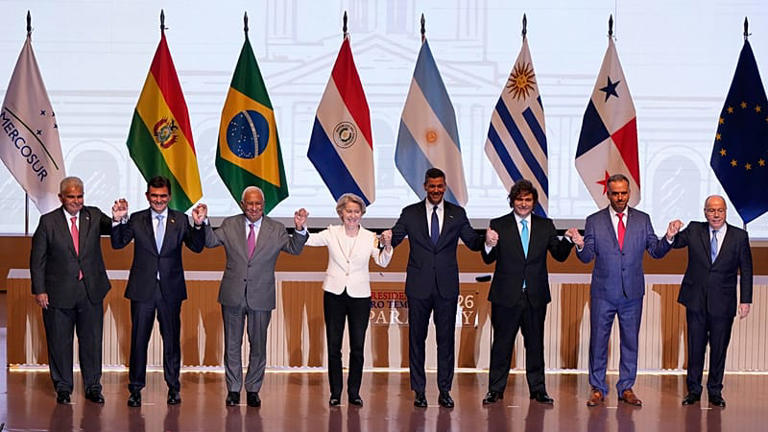
The European Union has formally sealed a long-negotiated and highly divisive trade agreement with South America’s Mercosur bloc, marking a major milestone in global trade and a turning point for EU economic strategy.
Speaking at the signing ceremony on Saturday in Asunción, Paraguay, European Commission President Ursula von der Leyen praised the agreement as a decisive choice in favor of openness and long-term cooperation.
Von der Leyen said the deal reflects Europe’s decision to embrace “fair trade over tariffs” and partnership over isolation, at a time when global trade tensions are rising. European Council President António Costa echoed that sentiment, describing the agreement as a clear defense of free trade rooted in multilateralism and international law, and a rejection of what he called the use of trade as a geopolitical weapon.
The Mercosur agreement — negotiated over a quarter of a century — would create one of the world’s largest free-trade zones, covering nearly 700 million people across Europe and South America. Under the deal, around 90 percent of tariffs on industrial goods, services, and agricultural products would be gradually eliminated.
The European Commission estimates that EU companies could save more than four billion euros annually in customs duties. Mercosur nations have also agreed to open their public-procurement markets to European firms on equal terms with domestic companies.
Beyond tariff reductions, the agreement includes protections for 344 European geographical indications, safeguarding products such as wines, cheeses, and regional specialties from imitation. It is also designed to secure access to critical raw materials, reducing Europe’s reliance on China for strategic minerals.
Despite its economic promise, the deal has exposed deep political divisions within the European Union. Supporters, led by Germany and Spain, argue that Europe urgently needs new trade partners as U.S. markets tighten and China adopts a more assertive trade posture. Opponents, spearheaded by France, warn the agreement could harm European farmers by exposing them to competition from lower-cost Latin American agricultural imports.
France attempted to block the deal but failed to gather a sufficient minority after Italy shifted its position at the last moment. Rome backed the agreement after securing financial support for Italian farmers starting in 2028 and an exemption from the EU’s carbon border tax on fertilizers.
Although France opposed the pact, it succeeded in negotiating safeguard measures. The agreement allows tariffs to be reintroduced if imports from Mercosur countries surge by more than five percent in sensitive sectors. It also places strict limits on agricultural imports. Beef imports, for example, will be capped at 99,000 tonnes annually at a reduced tariff, while poultry imports will be limited to 180,000 tonnes per year.
Commission projections show EU exports to Mercosur nations rising nearly 40 percent by 2040, while imports from Latin America are expected to grow by about 17 percent.
Still, French President Emmanuel Macron has warned that the signing does not mark the final chapter. With the agreement now concluded at the executive level, ratification moves to the European Parliament, where approval is required. Lawmakers remain sharply divided, largely along national lines.
Opponents are expected to challenge the deal as early as next week, when members of parliament vote on a resolution seeking to refer the agreement to the EU’s top court.
As the political battle shifts to Brussels, the future of one of the world’s most ambitious trade agreements now rests in the hands of Europe’s lawmakers.
Developed by Lisa Lomami.