Egyptian President Abdel-Fattah El-Sisi has issued a stark warning over Israel’s ongoing military operations in Gaza, cautioning that these actions risk triggering a broader regional conflict.
For the first time in nearly five decades, President El-Sisi referred to Israel as an “enemy,” a statement that underscores growing tensions despite the peace accord established between Cairo and Jerusalem in 1979. That historic treaty, stemming from the Camp David Accords, ended decades of hostilities, normalized diplomatic relations, and secured Israel’s withdrawal from the Sinai Peninsula.
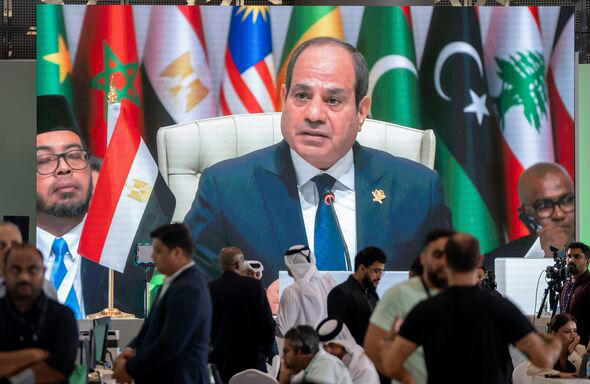
Speaking at an emergency summit in Doha, Qatar, convened by Arab leaders to condemn recent Israeli strikes, El-Sisi said:
“What is happening currently undermines the future of peace and places obstacles in the way of any opportunities for new agreements. What is occurring thwarts existing peace accords, and at that point, the consequences will be dire.”
The criticism comes after Israeli air and ground operations targeted high-ranking Hamas operatives in Doha, Qatar. Israel’s actions followed a surge in violence that has left more than 60,000 casualties in Gaza. El-Sisi emphasized that the Arab world must project unity, stating,
“Our positions must change the enemy’s view of us, so that it can see that any Arab country extends from the ocean to the Gulf.”
For years, Egypt has served as a mediator between Israel and Hamas, alongside Qatar. Yet, Cairo has historically maintained strict restrictions on movement through the Rafah crossing, frustrating Palestinians who argue that Egypt’s policies have reinforced Israel’s blockade of Gaza, in place since Hamas assumed control in 2007.
Humanitarian concerns also factor into Egypt’s cautious stance. According to U.N. reports, Egyptian authorities fear a large influx of displaced Gazans, for whom they could become responsible indefinitely. Egypt also does not want to participate in the permanent resettlement of hundreds of thousands of Palestinians.
El-Sisi’s remarks follow a complex history of Egyptian-Gaza relations. Between 2014 and 2016, Egypt’s military attacked tunnels connecting Gaza and Egypt, citing Hamas collaboration with the Muslim Brotherhood—a group the Sisi regime has aggressively suppressed since the 2013 coup that ousted President Mohamed Morsi.
Despite these historical tensions, 50 leaders from across the Arab and Islamic world convened in Doha for what has been described as an unprecedented demonstration of unity, responding to Israel’s surprise strikes on Qatari territory last week.
Meanwhile, Israeli Prime Minister Benjamin Netanyahu warned that further strikes could occur. When asked whether Israel might target Hamas operatives in other sovereign nations, he reiterated, “Terrorists should not have immunity, wherever they are.”
The situation remains volatile. Analysts warn that continued military escalation could destabilize the region, challenging historic peace frameworks and straining diplomatic relations. For now, the international community is watching closely, hoping for measured responses to prevent a broader regional conflict.
Reporting by Carl Montel.