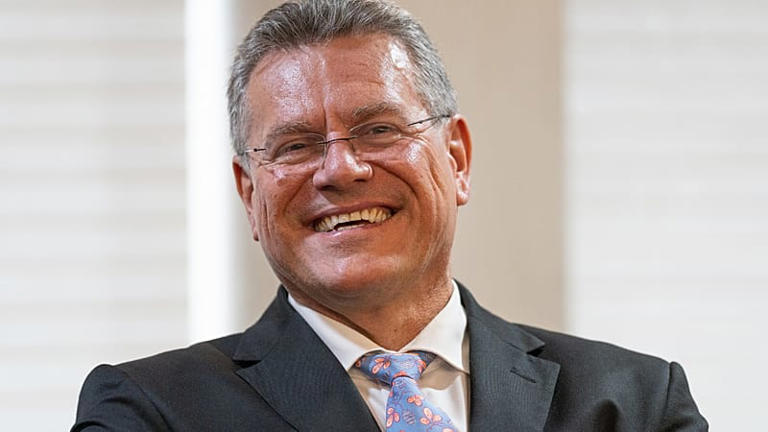
The European Union is on the verge of sealing a landmark trade agreement with India, a deal described by EU Trade Commissioner Maroš Šefčovič as the “mother of all deals,” poised to transform access to one of the world’s fastest-growing yet highly protected markets.
In an exclusive interview with Euronews from New Delhi ahead of the upcoming EU-India summit, Šefčovič revealed that the two sides are in the final stages of negotiation, “checking their final numbers” to finalize the agreement.
The deal aims to open a market of 1.4 billion people to European exports and services by significantly lowering India’s steep tariffs, which currently reach as high as 150 percent in certain sectors. These high duties have effectively blocked European companies from fully participating in key parts of India’s economy.
“In some sectors, India’s tariffs go up to 150 percent,” Šefčovič explained. “That has completely closed off large areas of the economy to European exporters. Now, the big benefit will be opening that economy.”
If finalized, the agreement would create a free-trade zone encompassing approximately 2 billion people, gradually eliminating customs duties on European imports into India. However, sensitive sectors for both parties will be excluded from the deal to ensure a balanced and positive outcome, according to the commissioner.
Currently, about 6,000 European companies operate in India, where trade in goods between the two blocs has surged nearly 90 percent over the past decade. In 2024 alone, European exports to India reached €48.8 billion, underscoring the deal’s economic significance.
Šefčovič called this the largest trade deal ever negotiated by the EU and emphasized its importance in the bloc’s broader strategy to diversify trade relationships beyond reliance on the United States and China.
“This agreement would provide insurance against global trade disruptions,” he noted.
India’s tariffs remain particularly high in part due to policies set during the Trump administration, which imposed prohibitive duties and additional penalties over India’s purchases of Russian oil.
For Brussels, concluding the deal would send a strong signal to other global trade partners, especially amid ongoing delays in ratifying the contentious Mercosur agreement, which have raised concerns about the EU’s standing as a major trading power.
Negotiations have proven challenging, with Šefčovič describing Indian negotiators as “very tough,” balancing India’s developing country status with the EU’s need to protect its interests.
One of the key unresolved issues remains sustainability, particularly India’s resistance to the EU’s carbon border adjustment mechanism.
The EU-India free trade agreement could be officially announced during the summit in New Delhi on Tuesday, potentially marking a new chapter in transcontinental trade relations.
Reporting by Lisa Lomami.