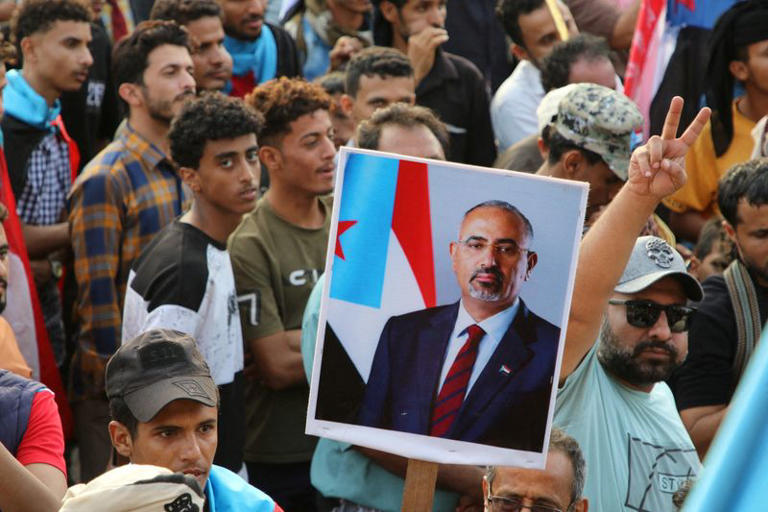
We turn now to southern Yemen, where the political and security crisis is deepening amid growing uncertainty over the fate of a key separatist leader—exposing sharp tensions between Saudi Arabia and the United Arab Emirates.
The leader of Yemen’s southern separatist movement, Aidarous al-Zubaidi, failed to travel to Riyadh this week for high-level talks aimed at easing the escalating crisis. His unexplained absence immediately fueled speculation and concern across the region.
Hours later, the Southern Transitional Council, or STC, announced that al-Zubaidi was in the port city of Aden, overseeing military and security operations. The group said it had lost contact with its delegation already in Riyadh, raising fresh questions about coordination and trust between allies.
An STC official insisted al-Zubaidi had not fled and was in a secure location, saying it was inappropriate for him to travel given the current security conditions. The official added that responsibility for the safety of the STC delegation in Riyadh now rests with Saudi authorities.
The developments dashed hopes for a swift resolution to the turmoil in southern Yemen, where recent fighting has exposed a deep rift between Saudi Arabia and the UAE—two powerful Gulf states that have long backed opposing factions in the conflict.
Saudi coalition spokesperson Turki al-Maliki earlier flagged al-Zubaidi’s disappearance, saying a plane carrying senior STC leaders departed Riyadh after hours of delay without him on board. Maliki accused al-Zubaidi of moving armed forces and distributing weapons in Aden in an attempt to incite unrest.
The Saudi-backed Presidential Leadership Council responded swiftly, dismissing two ministers and ordering arrests of individuals accused of threatening civil peace. It also stripped al-Zubaidi of his position on the council and referred him to prosecutors on charges including high treason, accusing him of inciting armed rebellion and attacking constitutional authorities.
In a significant political signal, al-Zubaidi’s deputy, Abdulrahman al-Mahrami, also known as Abu Zara’a, was tasked with maintaining security in Aden—an appointment seen as a sign of warming ties between Saudi Arabia and elements within the STC.
Meanwhile, Saudi-led coalition forces carried out pre-emptive airstrikes in the southern province of al-Dhalea, al-Zubaidi’s birthplace, after monitoring armed movements. Local sources report more than fifteen strikes in the area.
Saudi Arabia and the UAE first intervened in Yemen more than a decade ago after the Iran-aligned Houthis seized the capital, Sanaa. While the two Gulf powers initially fought side by side, the latest crisis underscores widening strategic differences—leaving Yemen’s fragile south facing renewed instability.
As diplomatic efforts stall, civilians once again bear the brunt of a conflict shaped by shifting alliances and regional rivalries.
Reporting by Carl Montel.